LoveHuddle News
Dating News: September 2026 — Safety, AI and a Shift Away From Endless Swiping
30 Sept 2026 · The dating world is changing — from online safety and AI to a growing demand for more genuine human connection.
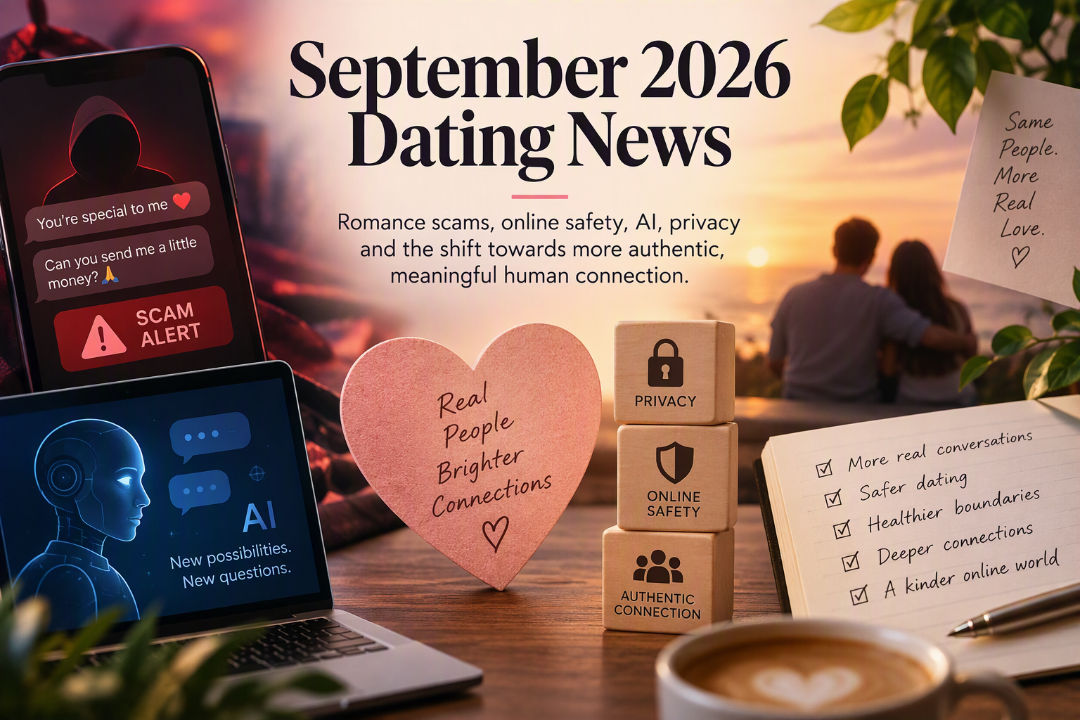
September has been a busy month in the dating world.
From growing concern about romance scams and online safety to new approaches designed to reduce endless swiping, the industry continues to change. Artificial intelligence is becoming more prominent too, while research suggests many singles are becoming increasingly deliberate about how, and who, they date.
Here are some of the biggest developments from the dating world this month.
Romance scams rise with younger adults increasingly affected
Online dating safety remains one of the industry's biggest challenges.
New figures released by Lloyds in September showed that reported romance scams increased by 24% over the previous year.
Perhaps surprisingly, the fastest increase wasn't among older people.
Reports involving victims aged 18–24 increased by 59%, while reports involving 25–34-year-olds increased by 39%.
Almost one quarter of reported victims were aged between 18 and 34.
Younger victims commonly reported first encountering fraudsters through dating apps and social media platforms. Older victims, meanwhile, continued to suffer some of the largest financial losses. Among victims aged 75–84, the average reported loss was £9,051.
The figures are another reminder that romance fraud isn't confined to one generation.
As AI-generated photographs, sophisticated fake identities and increasingly convincing conversations become easier to produce, establishing whether the person behind an online profile is genuine is becoming an increasingly important part of online safety.
National Trading Standards also reported at the end of September that 47% of UK adults believe it is becoming harder to distinguish what is genuine online, highlighting a challenge that extends well beyond dating.
Police warn about dating websites designed to keep people paying
Another dating-related concern highlighted this month involved websites charging users for individual messages.
Surrey Police and Sussex Police reported an increase in complaints involving online dating websites, many hosted overseas, where users purchase credits or virtual tokens to continue conversations.
Police said some victims had spent significant amounts of money before beginning to suspect that the people they were communicating with might not be genuine.
Warnings included sites potentially using fake profiles, automated accounts or operators whose purpose is to encourage users to continue buying credits rather than actually meeting somebody.
It's an important distinction.
Paying for a legitimate dating service is one thing. Designing conversations primarily to prolong spending rather than facilitate genuine human interaction is something very different.
Transparency around who people are communicating with, and
what they are paying for, is therefore likely to remain an important issue across the industry.
Dating apps experiment with life beyond the swipe
One of September's clearest themes has been the industry's continuing search for alternatives to repetitive swiping.
Major dating companies and newer entrants are experimenting with more social experiences, real world events and different ways of introducing people.
Tinder, for example, has been expanding its interest in real-world events as dating companies look for ways of creating interaction beyond simply browsing profiles.
Meanwhile, a new dating platform called Rivet launched in September with an unusual idea: instead of leaving every decision to the dater, volunteer community members can assess whether two strangers might be compatible.
The platform was founded by former Tinder executive Taru Kapoor and is designed to give users a smaller number of potential matches rather than an enormous stream of profiles.
Whether individual experiments succeed remains to be seen, but the wider direction is interesting.
The dating industry increasingly appears to recognise a problem users have been discussing for years: more profiles don't necessarily mean better connections.
What singles say they actually want
New research published in September offered another interesting perspective.
Match's 2026 Singles in America study surveyed approximately 5,000 single adults in the United States and found that many remained optimistic about relationships while becoming more selective about where they invest their time.
Some of the findings challenge the idea that dating is primarily about immediate physical attraction.
Nearly half of 49% said they had fallen for somebody they weren't initially attracted to.
Among those who had done so, great conversation was the most commonly cited reason for becoming interested, followed by shared interests and shared values.
The study also found that 41% would consider a second date even when the first date wasn't particularly exciting.
Perhaps one of the most revealing findings concerned emotional security.
When respondents were asked to choose between peace and emotional safety or passion and excitement, peace and emotional safety was selected by more than twice as many people.
The research was conducted in the US, so it shouldn't automatically be treated as representing singles everywhere. But it adds to growing evidence that many people want dating to feel less transactional and more meaningful.
AI is becoming a bigger part of dating
Artificial intelligence continues to move deeper into the dating industry.
Dating platforms are experimenting with AI for recommendations, profile assistance, conversation starters, photo selection and other parts of the user experience.
Tinder's chief technology officer said in September that the company is using AI across different stages of the dating journey, while other major dating businesses are also exploring how the technology can improve their products.
But AI creates an interesting contradiction for dating.
It can potentially improve safety, detect suspicious activity and help platforms operate more effectively.
At the same time, dating ultimately depends on authenticity.
If AI starts writing somebody's profile, choosing their photographs and composing their conversations, at what point are two people no longer getting to know each other', and instead getting to know technology speaking on their behalf?
That question is likely to become increasingly important as AI develops.
The challenge for dating companies may therefore be not simply asking what AI can do, but deciding what AI should do, and what should remain human.
Privacy remains firmly on the agenda
September also brought one of the month's biggest dating industry legal stories.
Grindr agreed to pay £26 million to settle a UK legal claim brought on behalf of approximately 12,000 users concerning allegations that sensitive personal information had previously been shared with third parties.
The allegations concerned historic practices, including highly sensitive health-related information.
The settlement involved no admission or finding of liability.
Regardless of the legal outcome, the case illustrates just how sensitive the information held by dating platforms can be.
Dating services can potentially hold information about location, sexuality, relationships, preferences and private conversations.
That makes privacy more than simply a technical compliance issue. For dating companies, trust and responsible handling of personal information are fundamental parts of the relationship between a platform and its users.
The bigger picture: dating technology is being reconsidered
Taken together, September's stories point towards something bigger happening across online dating.
The original dating-app revolution was largely built around convenience, enormous pools of potential partners and rapid decisions.
Now parts of the industry are experimenting in the opposite direction.
Fewer introductions.
More real-world interaction.
Greater emphasis on safety.
More verification.
Better conversations.
And more attention to whether technology is actually helping people connect rather than simply keeping them engaged.
None of this means swiping is disappearing tomorrow. Millions of people continue to use established dating apps, and the largest platforms remain significant businesses.
But the conversation surrounding dating technology is clearly changing.
The question is no longer simply how efficiently an app can show people to one another.
Increasingly, the question is:
Can technology create the conditions for two real people to actually connect?
That could prove to be one of the most important questions facing the dating industry over the next few years.
---
LoveHuddle News | September 2026
LoveHuddle News covers developments, research and conversations from across the dating and relationship technology industry. Our news coverage is intended to inform and does not endorse or criticise individual dating platforms.